 Folk
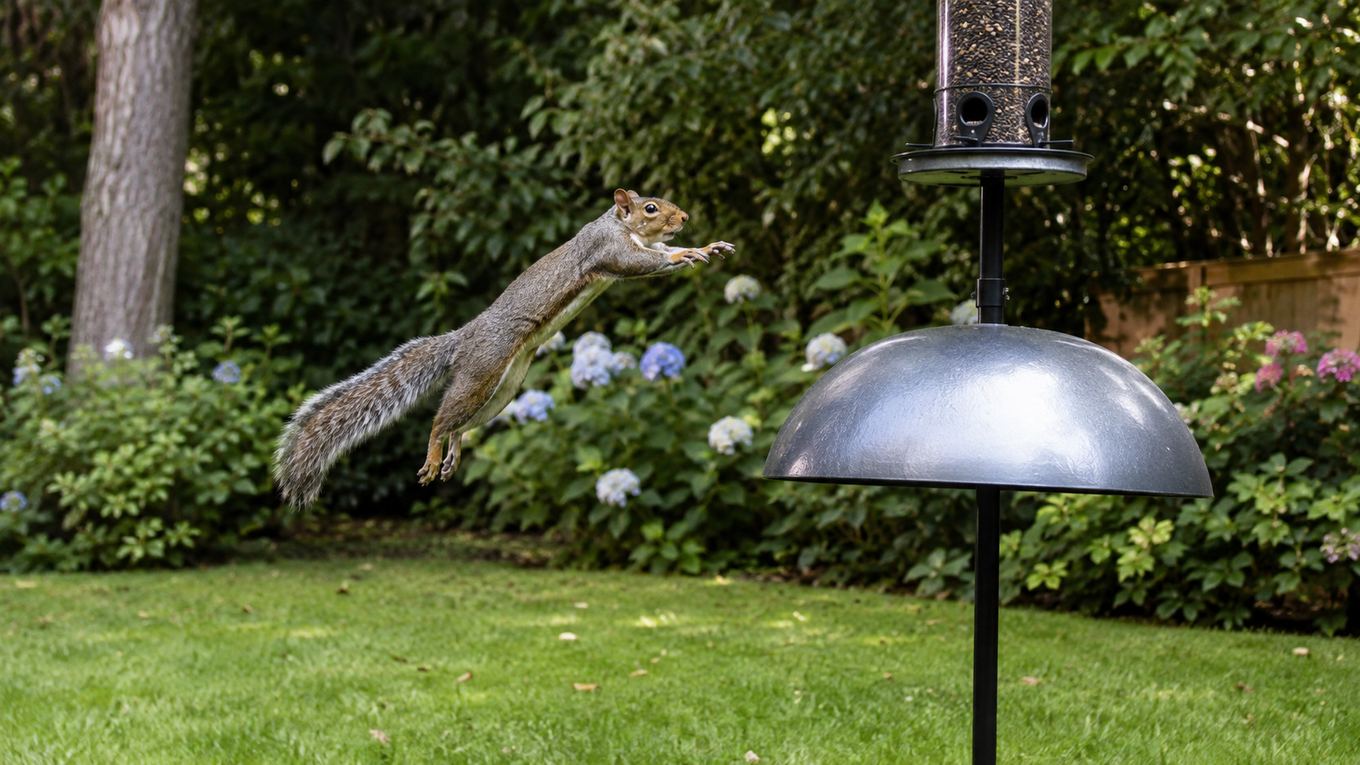
FolkSquirrels aren’t outsmarting you by accident — gray squirrels can jump roughly 8 to 10 feet horizontally from a raised launch point, which is farther than most feeder setups account for. The good news is that the physics work in your favor once you know the numbers: get the distances right and a squirrel simply can’t reach the feeder, no matter how motivated it is.
Why the usual fixes don’t hold up
Most squirrel “solutions” fail because they rely on the squirrel giving up rather than being physically unable to reach the feeder:
- Greased or petroleum-jelly poles wash off in rain and squirrels adapt to the slickness within days.
- Fake owls and other decoys lose their effect once a squirrel realizes nothing ever moves.
- Ultrasonic repellers have no strong independent evidence behind them for squirrels specifically.
The three things that reliably work are baffle height, pole distance from jump-off points, and feeder design — in that order of importance.
The 5-7-9 rule for pole placement
Backyard birders shorthand the core spacing guidance as the “5-7-9 rule”:
- Mount the feeder about 5 feet off the ground.
- Keep the pole at least 7 feet from anything a squirrel could launch from horizontally (fences, deck rails, low branches).
- Stay clear of anything 9 feet above the feeder that a squirrel could drop down onto.
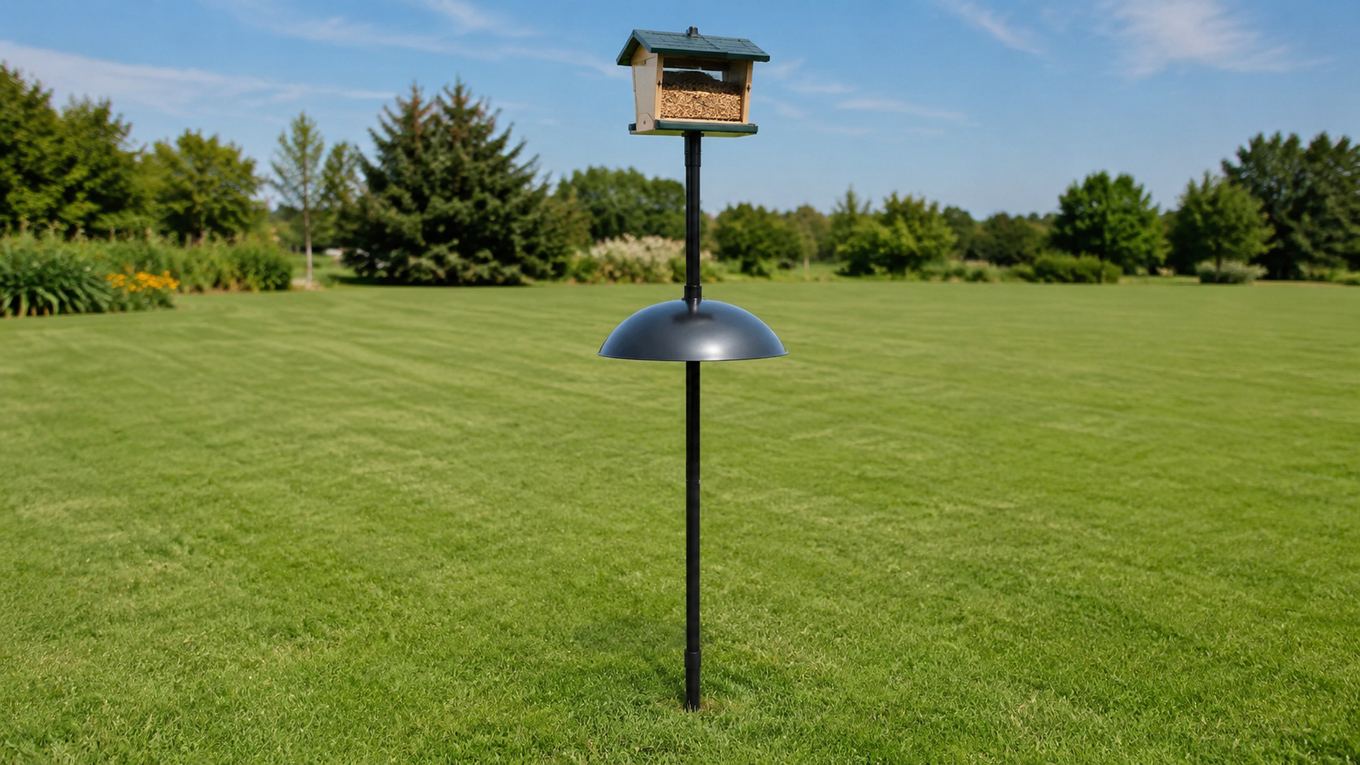
Cornell Lab’s more detailed guidance lines up with this: place the pole in open ground at least 8–10 feet from trees, fences, decks, and rooflines, since that’s the outer range of a squirrel’s horizontal jump from an elevated start.
Recommended gearExample: a dedicated squirrel-proof pole and baffle system
Get the baffle right
A baffle only works if it’s sized and placed correctly — an undersized or too-low baffle just becomes a launching pad.
- Height: mount the baffle 4–5 feet above the ground. Below 4 feet, squirrels can jump over it from a standing start.
- Diameter: 18 inches is the standard size for a dome (cone-shaped) pole baffle; anything narrower gives squirrels enough of an edge to grip and climb around.
- Position: it needs to sit below the feeder on the pole, not above it — its job is blocking the climb up, not blocking a jump down.
For the full step-by-step, see our baffle installation guide.
Squirrel deterrent methods compared
| Method | How it works | Effectiveness | Upkeep |
|---|---|---|---|
| Pole + dome baffle (5-7-9 rule) | Physically blocks climbing and jumping | High, if distances are correct | Low — check after storms |
| Weight-activated feeder | Closes seed ports under squirrel body weight | High for feeder-specific access | Low |
| Cage/mesh feeder | Wire cage lets small birds through, blocks squirrel body | High | Low |
| Capsaicin (hot pepper) seed | Irritates mammals, doesn’t affect birds | Moderate, some squirrels adapt | Reapply with each refill |
| Greased pole | Makes climbing surface slippery | Low, washes off and squirrels adapt | High |
| Decoys (fake owls, etc.) | Relies on squirrels perceiving threat | Low, squirrels habituate fast | Low |
Feeder design is your backup layer
Even with a perfect pole setup, squirrels will occasionally find a way — a feeder built to resist them adds a second line of defense:
- Weight-activated feeders use a spring-loaded perch or cage that closes off seed access once something heavier than a typical songbird lands on it.
- Cage or mesh-enclosed feeders put a wire barrier around a standard feeder, sized to let small birds reach the ports while keeping squirrels’ bodies out.
Our comparison of tube, hopper, and platform feeders covers general squirrel vulnerability by feeder type if you’re still deciding what to buy — see our roundup of the best squirrel-proof feeders for specific picks.
Does hot pepper seed actually work?
Short answer: yes, but it’s not a complete solution on its own. Birds have no capsaicin receptor and don’t react to it at all, while it genuinely deters most mammals. The catch is that some individual squirrels build up tolerance over time, so treat it as a supplement to correct pole placement, not a replacement for it. We cover this in more depth in our capsaicin seed myth-check.
Set up your station, step by step
- Pick a pole location at least 7–10 feet from fences, decks, trees, or anything else a squirrel could jump from.
- Mount an 18-inch dome baffle 4–5 feet above the ground on that pole.
- Hang the feeder above the baffle, keeping the whole assembly clear of anything overhead within a 9-foot drop.
- Choose a weight-activated or cage feeder as a second layer, especially in yards with heavy squirrel pressure.
- Recheck the setup after storms or ground settling — baffles that tilt or poles that lean lose their effective height fast.
Once your station is squirrel-resistant, the rest of your feeding setup can focus purely on the birds — see our complete guide to feeder types for what to fill it with.