 Folk
Folk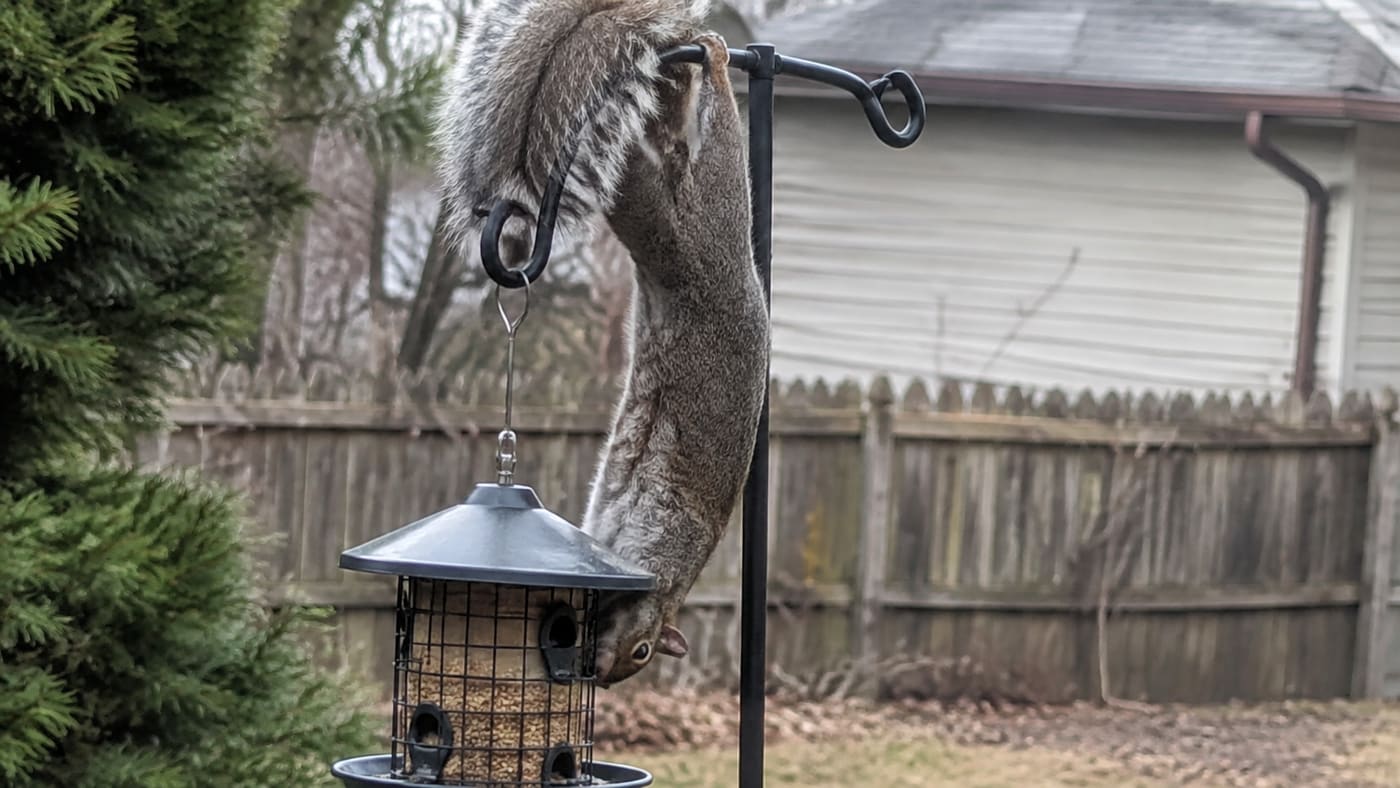
I want to be clear that I did my research. Before I bought the feeder in question, I read reviews. I looked at the weight-activated closing mechanism. I convinced myself, genuinely, that this was the feeder that would end it.
It lasted eleven days.
The squirrel — I’ve started thinking of him as Gary, for no particular reason except that he needed a name and Gary felt right — figured out early that the perch ring closed off the seed ports under his weight. So he stopped using the perch ring. Instead he hangs, upside down, from the pole above the feeder, and reaches down with one paw to scoop seed out through the port before it has a chance to close. It should not work. It clearly works.
The first time I caught him doing it, I actually went and got my phone, half-expecting the trick to fall apart the moment I paid attention to it. It didn’t. He hung there, perfectly still except for the one working paw, for almost a full minute, methodically working through one port and then unhurriedly swinging over to the next like he was working a shift. I’ve since learned this is apparently common enough that it has a name among people who study this sort of thing — but “counter-strategy” doesn’t quite capture how deliberate it looked in person.
I’ve watched him do this at least a dozen times now, and every time I have the same two reactions in quick succession: genuine irritation that the thing I paid for is not doing its one job, followed almost immediately by a kind of reluctant respect. This is a squirrel who identified the exact failure condition of an engineered mechanism and built a whole physical technique around exploiting it. I don’t know what I expected, honestly. Squirrels have been getting into bird feeders since bird feeders existed, and every “solution” is really just the next move in a very long game.
What I’ve settled on, at least for now, isn’t a better feeder — it’s giving Gary somewhere else to be. I moved an old, cheap feeder we weren’t using to a spot on the far side of the yard, well away from the main feeding station, and started putting whole corn and a handful of peanuts in it instead of the good sunflower seed. It’s not a perfect fix. He still checks the main feeder most mornings out of what I can only describe as principle. But he spends noticeably more time at the decoy station than he used to, and the birds get a longer uninterrupted stretch at the real feeder because of it.
If Gary — or your own yard’s version of him — is a newer problem for you, it’s worth reading through an actual structured approach before you improvise one. I went in with a single “squirrel-proof” product and no backup plan, which in hindsight was the mistake. The complete guide to squirrel-proofing bird feeders lays out the combinations that tend to actually hold up — baffles, pole placement, distance from jump points — rather than betting everything on one clever mechanism.
I’ll probably try a baffle next. I’ve heard they work well. I’ve also heard that from people who haven’t met Gary.
Comments
Loading comments…
Leave a comment